Showing posts with label Lecture notes. Show all posts

Friday, 16 March 2012

Bruno Maag

Today we had a guest lecturer in, Bruno Maag.
He informed us on the history of typography

  • 5000BC cave drawings - record of events
  • Egyptian Hieroglyphics - evolved
  • Greek script - Rosetta stone covers three stages: Egyptian, Phenetian, Greek 
Boustrophidon - writing changing direction
                       - lasted about 100years

Roman Empire built over around 600years - 100AD
Introduced branding - Trojan column
Said to be the best lettering ever produced - evenly spaced and harmonious

Implanted roman script everywhere they landed so people knew they were in the Roman Empire.

450AD Book of Kels - Original in Dublin written by four people in the Alps - 2 Italians (More flourished) 2 Germans (more precise) - same lettering style.

42 line bible - Gutenberg - industrialized information - helping knowledge spread - original in Bridge Library in London.

Friday, 2 March 2012

Semiotics continued

Saussure identified 3 areas to consider in deciphering how meaning is formed;

  1. Signs themselves
  2. The way they are organised into systems
  3. Context in which they appear.
Meaning they can vary depending on the reader/ viewer. Interpretation isn't fixed - it can be changed.

Pierce 3 levels for signs;
  1. Firstness - a sense of something, feeling/mood. (subjective)
  2. Secondness - level of fact/ literal/ fundemental
  3. Thirdness - level of general rules (culturally specific) that bring two levels together in a relationship

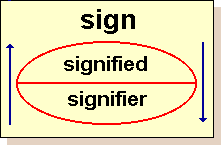
Signifier - the word 'Open'
Signified concept - open for business.

In order to understand the meaning from a sign we need to consider the structure.
Pierce's model identified 3 categories or signs.
  • Toilet Signs - Iconic- signifier is perceived as imitating the signified
  • Footprints - Indexical - signifier is not arbitrary but directly connected
  • Road Signs - Symbolic - signifier does not resemble signified. It is fundementally arbitrary or purely conventional so relationship must be learnt.

Semiotics - study of signs


Everything that we see has a place in culture.
Everything in some sense is a sign.
Truth? Don't look for it anymore.


Signified - conceptSignifier - thing that carries the meaning (Material thing)Cannot have signifier without signified.Concept - tree  - signifiedSound pattern   - signifier - thing you can see/hear
  • Roland Barthes - mythologist book - used semiotics to examine popular culture artifacts.

Language - denotation - literal meaning, 1st order signification, visibly present
Myth - connotation - rhetorical meaning, 2nd order signification, suggested by the image/idea.

Daniel Chandler - very inciteful (use for essay) http://www.aber.ac.uk/media/Documents/S4B/sem06.html

"an image is a sight which has been recreated or reproduced" - Berger
"Seeing comes before words. The child recognises before it can speak" - Berger

  • Charlie Parker - graphic designer - nature
  • Abram Games - graphic designer - A lot of clever metaphors and signs.
  • Grayson Perry
Linguistics - study of language
Semiotics - science of signs

Meanings that are made through 'theorema' meaning to view, observe and reflect.
Semiotics derives from the study of linguistics.
Language is both constructed and inherited, culturally specific, a system of signs, organised in codes and structures.

Friday, 24 February 2012

Appropriation


As a term in art history and criticism refers to the more or less direct taking over into a work of art of a real object or even an existing work of art.
The practice can be tracked back to the Cubist collages and constructions of Picasso and Georges Braque made from 1912 on, where real objects such as newspapers were included to represent themselves.

Friday, 17 February 2012

Sites of Display

Muse Wormiani - cabinet of curiosity reflected power of collectors

Galeria Milan - industrial - based on Passage des Panoramas - Paris 1799
Leeds victorian quarter - 19th century iron and glass roof - Barrel vault.

"All that is said melts into air"
Use value- is it doing its job?
Exchange value - what is it worth?

Neo Avant Garde practices 1960's onwards.
Sophie Calle - collects in cabinet - updated.

Quiz


  1. What was the name of the famous international photographic exhibition of the 1950's that showed images of life and work from around the world? Family of man
  2. Who argued that beauty is in the eye of the beholder? Immanual Kant
  3. What is an isotype? Symbol/image thats not culturally specific.
  4. In what year was the festival of britain? 1951
  5. What was the significance of the helmet in the festival of britain logo? Britania/ Roman empire
  6. In what decade was the first photograph taken? 1820's
  7. What is an indexical sign? Shadow / smoke - indicates something was there.
  8. Who coined the phrase 'form follows function'?Louis Sullivan 
  9. To which country did the futurists belong? Italy
  10. What was the name of the building in which the great exhibition was held? Crystal Palace
  11. what dates marked the beginning and end of the modern period? 1860-1960
  12. What was Haussmanisation? Rebuilding of Paris
  13. Who reffered to his typography as 'words in freedom'? Marinette
  14. To which art movement does the idea of automatic drawing belong? Surrealism

Friday, 10 February 2012

Yorkshire Sculpture Park

Today we visited YSP and looked around. Unfortunately the weather was terribly cold and they were in the process of changing the exhibitions so there was not much to view but what I did see before my fingers and nose dropped off was pretty cool.

Friday, 3 February 2012

Avant Garde continued

'The Incoherents' - Art nouveau - group of artists to look into.

Avant Garde started in around 1912 with Futurism - right wing radical

- Futurist typography "words of freedom" words are read differently in different fonts.
- DADA 1916 - Switzerland like futurism it rejected the past but instead rejected art (Anti-art) paradoxical term. Art but not art.

  • Raoul Hasmann - DADA cino - montage - practice that is discontinuous - preserve identity                                                   collage - make items(newspaper, material etc.) into something else e.g. foil into guitar
- DADA - cities over countries
- Automatism - Andre Masson 1924 - suppressing conscious response and letting the pen flow freely.

  • Marinetti Boccioni - futurist music - geometric shapes, mechanical aesthetics
- Futurists make words fit together
- DADA pull things apart

  • Tristan Tzara - DADA poet
  • Kurt Schwitters "Never do what someone has done before you" 

Avant Garde

Modern period - 1860-1960 - avant garde falls within (1912ish)

Concerned with modernity - political and aesthetic
Modernism - radical aesthetics (no politics)
Begining of moder period - money replaces status/monarchy

  • 1910 - Futurism(Italian) - Marineth - leader
  • 1916 - Dada
  • 1920 - Constructivism(Russian) 
  • 1920 - Surrealism - automatism
features of Avant garde include discontinuity.

Gustave Courbet - Realist - show world what it is
                                        - large scale / in your face
Honore Daumier -  Trains part of modernisation

Paris was rebuilt because of a cholera outbreak
Stop further revolutions - less place to run away and hide an wide streets were good for moving troops.
Increase in shops - modernity.

Middle class took over lower class in city, more apartments in center - more money.

Festival of Britain 1951


Ended the Elizabethan journey regrouping everyone after the war. Became tradition making ancestors proud.
1962 "You've never had it so good" Projecting positive image/ building moral/ increasing popularity.

Nation as a family - Metaphor/ portraying a message.

Logo

  • Bunting - fair, party, celebration
  • Helmet - classical
  • Compass - directions
Designed by Abraham Games the logo was used all over. 
After war everything was black with coal - festival was designed to be colourful and bright.
A lot of contempory art was included such as sculptures to help people to look to the future.


Friday, 27 January 2012

Modernism

Roughly 1860-1960 (Modern period)

Pre-modern - Traditional
Post-modern - roughly 1960's - turning point

  • Modernisation - technology/ rationalisation/ industrial
  • Modernity - modern society/ to live
  • Modernism - critical theory in arts
1860's beginning of modern Paris. All got re-built to accommodate commercialistation.
  • Capitalism
  • Commercialisation
  • Comodity 
All kicked off by French revolution and industrial revolution.
Modern - about the present rather than the past.

Crystal Palace (1851) year of great exhibition
Joseph Paxton - based on greenhouse
Pre-fabrication - factory produce elements for building so it is cheap and can be taken down and re-built easily.
Modernism attempts to be universal.


Friday, 9 December 2011

Mechanical reproduction


Some time in the 1980s The Guardian ran an April fool’s article on the ‘first’ photograph. Shown on the front page this was deemed to have been taken in the 1790s by a monk in Japan. - spoof.

The first authentic photograph is the fixing of a camera obscura image.
The means of fixing an image is all that distinguishes a photograph from a projected image.
Does the camera see what we see?

When we speak of a copy without an original we call it a ‘simulacrum’.
Roland Barthes meditated on the photograph for much of his professional life. His book Camera Lucida best shows this. There he reproduces a photograph of a condemned man and adds the remark ‘he is dead and going to die’. This too raises the question of temporality – we see that he is alive in the photograph but we know he is dead – there is a conflict between perception and memory.

The difference between photographs and paintings is more than a matter of their resemblance to things or even their resemblance to each other. Often a painting is said to be ‘photographic’ when it is realistic. Yet we know that photographs may not appear to be realistic.


  • Conventional signs/ image - letters, punctuation, words etc.
  • Iconic signs/ image - pictures
  • Indexical signs - indicates something: Shadow indexical of man/ smoke indexical of fire/ footprints etc
Indexical is evidence of presence e.g photograph.

Photo is documenting truth - manipulating this brings it back to painting.

Simulacrum - a copy without an original

Friday, 2 December 2011

Word and Image

"Making comes before matching" - E.H. Gombrich
Visual/ Pictures - Right side of the brain
Verbal/ Speech - Left side of the brain
Drawing on the right side of the brain by Betty Edwards


Difficulties of drawing is overcoming what you know about a thing in favor of what you see in a particular instance.

In history, the first written language used images (Hieroglyphics).

Friday, 25 November 2011

Harvard referencing

This seminar was a brief overview of Harvard referencing. Personally I still don't understand! Been set 2 essays already so I guess I better get on Google and in the library to try and understand!

Friday, 18 November 2011

John Ross

Guest lecturer John Ross showed us some of his work in print making mixed with comic writing.
He told us that we should use strengths apart from art in our work, so if we have a hobby or passion to use it.

Think the opposite. May help idea generation.
Technique should be developed to be able to make idea work.

Ralph Steadman is an illustrator that lets loose. His work is very free and interesting including really strange things that were going through his head at the time.Animal Behaviorist #1

Lesson learnt - do not hold back!!

Friday, 11 November 2011

Stephen Raw


Guest lecturer Stephen Raw informed us today that work can help people, not just look good. I found his work fascinating how it all generally looks the same using his own signature type face yet by using different colours, phrases and materials can make them completely different.

Type - can be absent to receive information
Oral - have to be present.

Consider all areas including;

  • Calligraphy
  • Rubbings
  • Put all work in if they would like it or not
  • There is no right or wrong just appropriate
  • Size and materials

Typography - Bad

There are lots of kinds of bad typography;

  • Unreadable text
  • Too busy or messy
  • Spelling errors
  • Bad spacing

Here is an example of how bad spacing can effect the text drastically. This sign is meant to say 'Final Registration' but as the letters are too close together it ends up changing the word 'Final' completely.

Typography - Good

Yulia Brodskaya - 
 

I think the work of Yulia is classed as good because it is unique, intriguing and different using quilling to enable the text to be bold and legible.

Craig Ward - 

I enjoy Craig Ward's work as it is very literal. The words and the design fit together well. His work is recognisable and simplistic.


Friday, 28 October 2011

Typography


Typography - form - writing
                    - visual grammar
                    - visual communication

The arrangement of words and phrases to create well-formed sentences in a language.
Typography is the art and technique of arraigning type in order to make language visible.
The arrangement of type involves the selection of typefaces.
Typography is the practical and artistic arrangement of type and printing with type.

Aesthetics continued


Seminar groups to consider the value of aesthetics in contemporary visual culture 


What beauty is about? - Functional, Emotion, Pretty, Neat, Fun. Pleasant things work better.
Fear effects the way the brain works.
The use of candy to make people happy easier to solve problems.
To get work done you must set a deadline taste, sound, colour, appearance - visceral level - subconscious behaviour, walking, talking.

Aesthetics - the brand of philosophy dealing with such notions as the beautiful, the ugly, the sublime, the comic, ect.
As applicable to the fine arts, with a view to establishing the meaning and validity of critical judgements concerning works of art, and the principles of underlying or justifying such judgements.